


 Global
  United States
 Japan
Japan 






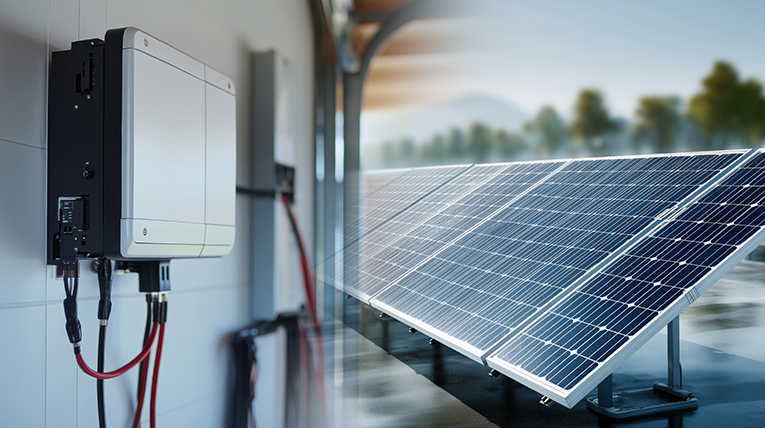
As electric vehicles (EVs) rapidly scale across global markets, a new challenge — and opportunity — is emerging beyond the road: what happens to EV batteries after their automotive life ends?
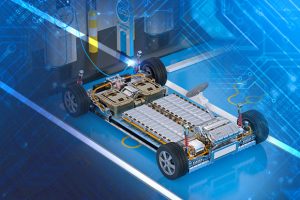
While EV batteries may no longer meet the stringent performance requirements of vehicles after 6–8 years, they often retain 70–80% of their original capacity. Instead of being discarded or recycled prematurely, these batteries can be repurposed into second-life energy storage systems.
At the heart of enabling this transformation lies a critical technology: Smart Hybrid Inverters.
In this blog, we will understand how smart hybrid inverters play a critical role in enabling the safe, efficient and scalable reuse of second-life EV batteries across energy storage applications.
Table of Contents
Understanding Second-Life EV Batteries
EV batteries are typically retired from vehicles when their range or peak power capability declines. However, for stationary energy applications such as:
- Residential energy storage
- Commercial backup systems
- Renewable energy buffering
- Microgrids and off-grid installations
These batteries still offer significant usable life.
Second-life batteries provide:
- Lower-cost energy storage
- Reduced environmental impact
- Delayed recycling and material recovery
- Improved ROI across the battery lifecycle
Yet, integrating these batteries safely and efficiently is not straightforward.
Why Second-Life Batteries Need Smart Power Electronics
Unlike new battery packs, second-life EV batteries present unique challenges:
- Non-uniform aging across cells
- Variations in State of Health (SoH)
- Different chemistries and pack architectures
- Inconsistent voltage and capacity profiles
This is where smart hybrid inverters become essential, acting as the intelligence layer between energy sources, batteries and loads.
What Is a Smart Hybrid Inverter?
A smart hybrid inverter is an advanced power conversion system capable of managing:
- Solar PV input
- Grid interaction
- Battery energy storage
- Load prioritization
all through intelligent control algorithms and real-time monitoring.
Unlike conventional inverters, hybrid inverters are bi-directional, allowing energy to flow both into and out of battery systems while dynamically optimizing performance.
How Smart Hybrid Inverters Enable Second-Life Battery Usage
1. Intelligent Battery Management Integration
Smart hybrid inverters work alongside Battery Management Systems (BMS) to:
- Monitor voltage, current, temperature and SoH
- Adapt charging and discharging profiles dynamically
- Isolate weak or degraded battery modules
- Extend remaining battery life
This adaptability is critical when working with aged EV batteries.
2. Voltage and Power Matching
Second-life EV batteries often operate at non-standard voltage ranges.
Hybrid inverters enable:
- Wide DC input voltage support
- Dynamic power derating
- Safe operation despite capacity variations
This allows batteries from different EV platforms to be reused without extensive redesign.
3. Seamless Renewable Energy Integration
When paired with solar or wind systems, hybrid inverters:
- Store excess renewable energy into second-life batteries
- Supply clean power during peak demand
- Reduce grid dependency
This makes second-life batteries ideal for distributed energy storage and behind-the-meter solutions.
4. Grid Support and Energy Optimization
Advanced hybrid inverters support grid-interactive functions such as:
- Peak shaving
- Load shifting
- Time-of-use optimization
- Backup power during outages
Second-life batteries thus become valuable grid assets rather than passive storage.
5. Enhanced Safety Through Software Intelligence
Safety is paramount when dealing with aged batteries.
Smart hybrid inverters ensure:
- Multi-level protection mechanisms
- Thermal monitoring and fault isolation
- Controlled current ramps
- Predictive fault analytics
This software-driven safety approach significantly reduces operational risks.
Key Applications of Second-Life Battery Systems
With smart hybrid inverters, second-life EV batteries can be deployed across:
- Residential energy storage systems (ESS)
- Commercial and industrial backup power
- EV charging stations with buffer storage
- Telecom and data center backup
- Microgrids and rural electrification
These applications demand reliability, adaptability and intelligent control — all enabled by hybrid inverter platforms.
Sustainability and Circular Economy Impact
Repurposing EV batteries aligns strongly with global sustainability goals:
- Reduces raw material mining
- Lowers battery lifecycle carbon footprint
- Supports circular economy models
- Improves overall EV ecosystem economics
Smart hybrid inverters act as the bridge between mobility electrification and energy sustainability.
The Road Ahead
As EV adoption accelerates, the volume of retired batteries will grow exponentially. Unlocking their second life at scale will depend on:
- Advanced power electronics design
- Intelligent control software
- Scalable manufacturing of inverters and ESS
- Standardization and safety compliance
Smart hybrid inverters will play a defining role in ensuring that EV batteries continue delivering value — long after they leave the vehicle.
Scenario1: Day (High Solar Generation)
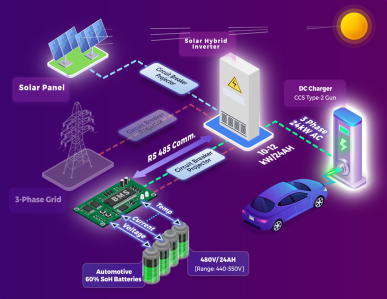
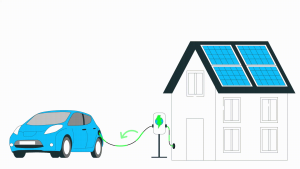
EVs and batteries are powered entirely by excess solar energy, with the hybrid inverter intelligently managing seamless power distribution – ensuring zero grid usage.
Scenario2: Afternoon (Solar Generation = Load)
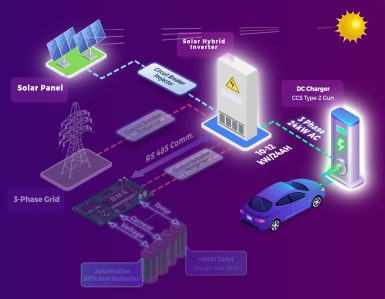
EV charging is powered entirely by solar energy, while the batteries remain fully charged in standby – ensuring zero grid usage
Scenario3: Night (No Solar Generation)
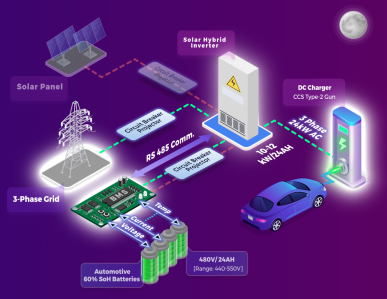
Batteries initially power EV charging. Once it reaches a low state, the Hybrid inverter seamlessly switches to grid power to supply the EV charger and recharge the battery, ensuring continuous operation and battery protection.
Conclusion
Second-life EV batteries represent one of the strongest opportunities to build a sustainable and circular energy ecosystem. However, realizing their full potential requires deep expertise in power electronics, battery systems, control algorithms and manufacturing scalability.
VVDN, as a product engineering and manufacturing company, possesses end-to-end technical capabilities across power electronics design, inverter development, BMS integration, embedded software, system validation and mass manufacturing. Our dedicated power electronics engineering teams have deep expertise in this domain and can support the design and manufacturing of smart hybrid inverters and hybrid EV charging solutions tailored for next-generation energy systems.
If you have a project or concept around second-life EV batteries, hybrid inverters or advanced energy storage solutions, feel free to reach out to us at info@vvdntech.com.
We can support you from idea and conceptualization — all the way to production scale.